Quick start 3 — expose a governed Data API service
Goal: give another app or partner a read-only JSON endpoint over your data — without exposing SQL, credentials or your database. ~10 minutes.
Agent Flows → Data API: define service → test → mint token → consumers call /v1/<slug>
1. Define the service (Agent Flows → Data API)
Open Agent Flows, switch to the Data API tab, and + New service:
- Slug — the URL name, e.g.
top-customers. - Source — which connector it reads.
- Kind —
sql(a storedSELECTwith:nameparameter placeholders),routine(stored procedure / SAP BAPI), orapi(a SaaS object fetch, e.g. HubSpot contacts).
SELECT customer_id, company_name, SUM(amount) AS revenue
FROM   orders JOIN customers USING (customer_id)
WHERE  order_date >= :since
GROUP  BY 1, 2
ORDER  BY revenue DESC
LIMIT  :top
Callers may only pass the parameters you declare (since, top) — never arbitrary SQL. Optionally add a mediation transform (filter rows, cast/rename columns, computed columns) and set concurrency, timeout, retries and a per-service rate limit.
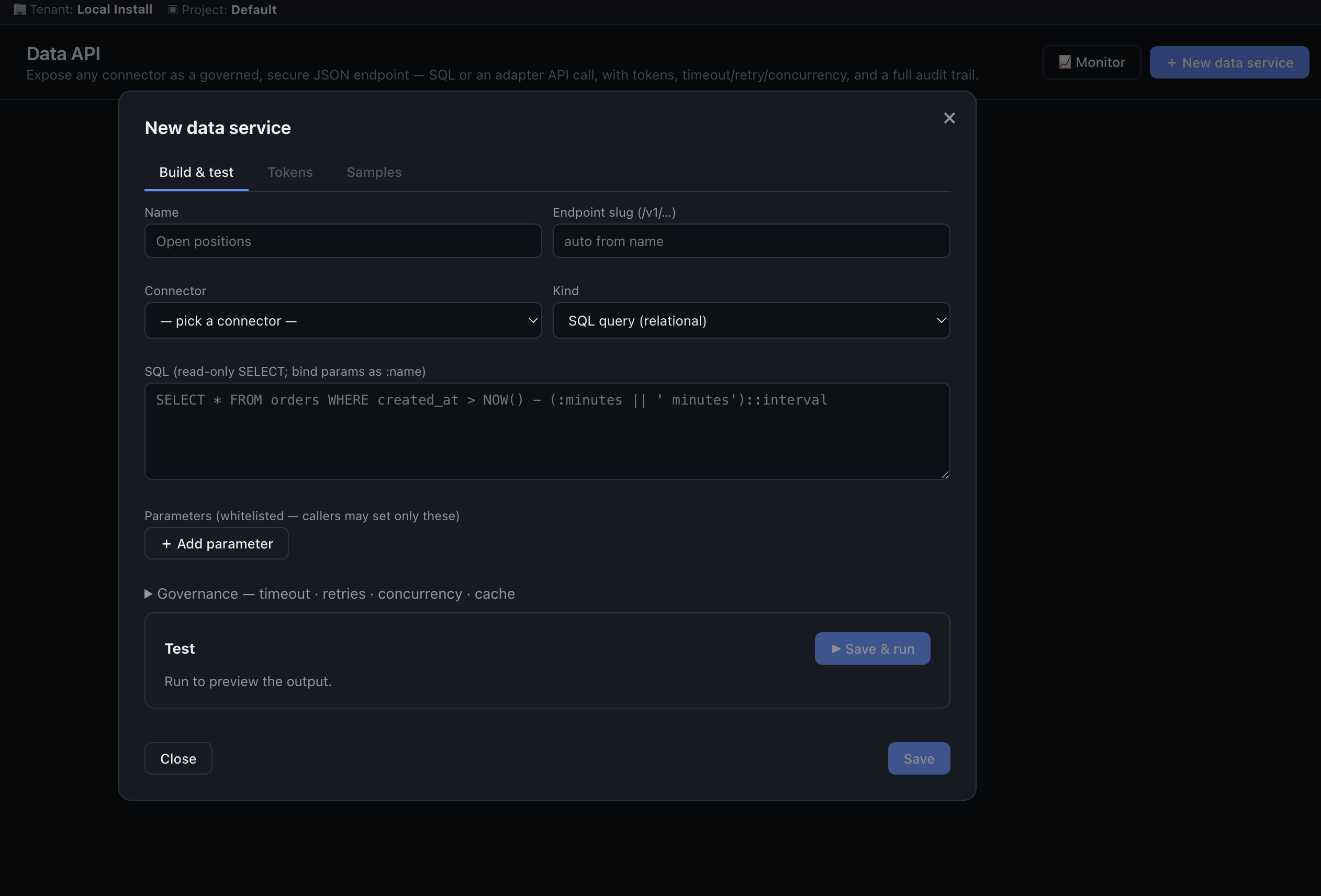
2. Test, then mint a token
Test runs the service with sample parameters and shows the exact JSON consumers will get. When it looks right, + Token — copy it once (tokens are stored hashed), set an expiry, and later rotate (successor with a grace window) or revoke it without touching the service.
3. Call it
curl "https://your-dataapi-host/v1/top-customers?since=2026-01-01&top=10" \
  -H "Authorization: Bearer <token>"
# → { "columns": [...], "data": [...], "meta": {...} }
Three call styles, no extra work:
- Paged extracts —
?offset=N&limit=M;meta.next_offsetwalks millions of rows in bounded pages. - Async —
?async=1returns a job id to poll; the run goes through a durable Postgres-backed queue. - Scheduled — give the service a cadence and AgentData enqueues the call itself — a lightweight recurring sync.
4. Watch it
The Data API monitor (Monitoring) shows queue depth, per-service call counts, error rates, p95 latency and the recent-call log — every call is audited.
The Data API is one of three data-movement paths — batch Flows, real-time Streamer, governed Data API out. Data movement compares them.
Identity boundary
A service token authorizes the defined Data API service; it does not impersonate an arbitrary Entra/AD user. During enterprise identity cutover, legacy shared-credential services are quarantined unless their execution path is explicitly supported. Use the certified delegated endpoint for user-scoped Microsoft access, and verify a denied user receives no protected result or metadata.